


Two developments in the actual “open” AI space over the last couple of weeks put an argument from my last piece to the test - that open source tends to win the platform fight, and that the value ends up in the services layer wrapped around the technology rather than in the technology itself. First, NVIDIA bought Hugging Face for nearly $13 billion. Hugging Face has never turned a profit. So why the buy?
There is no question that NVIDIA has an incentive to embrace the open model world more aggressively. Google makes its own chips. Amazon makes chips for both AI training and inference. Meta makes its own chips. OpenAI paired up with Broadcom, making Microsoft’s move to develop its own custom silicon even more important.
Given the initial OpenAI / Microsoft relationship, Microsoft may have been left a bit behind on its own AI ambitions. The hardware business NVIDIA is in also has traditional competitors like AMD and Intel that want a piece of the massive capex the AI buildout is generating.
NVIDIA is currently the largest company by market value in the world - worth over $5 trillion. That is why all the companies above are now in the chip business. It’s a good business to be in and a very profitable one - NVIDIA made nearly $60 billion in profit just last quarter.
Here are the top ten global companies by market capitalization over the last ten years.
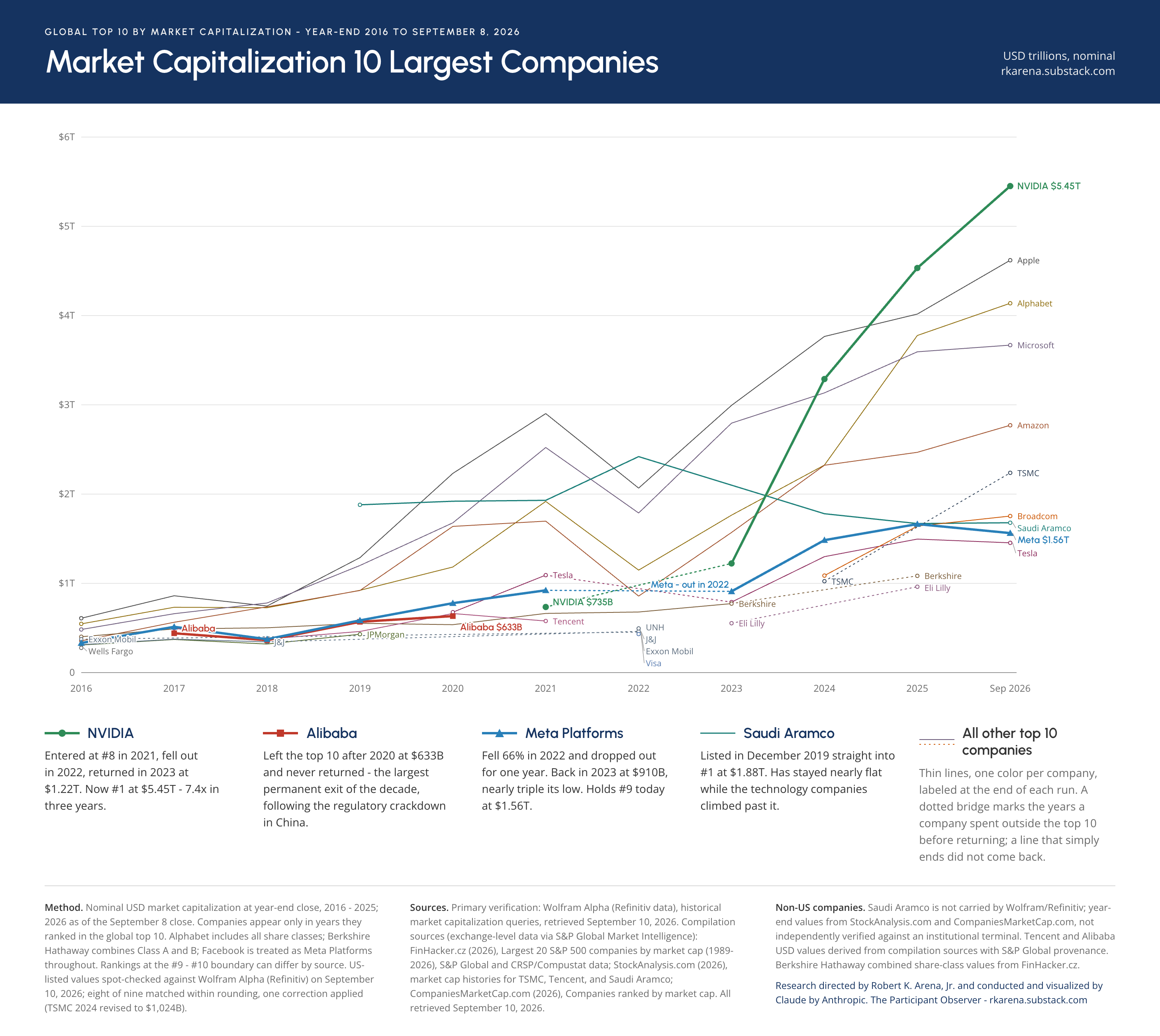
NVIDIA not only has the market cap, it has the profits too. Whether OpenAI or Anthropic is profitable is not public. SpaceX is not, and Tesla barely is, at just around $4 billion in profit last year. As the chart above shows, maintaining a large market capitalization over time is no guarantee. NVIDIA sees a long-term threat to its chip business and is staking a big claim in the open model space with the Hugging Face acquisition.
The second development shows what that looks like in practice - a recent article in the New York Times, Corporate America Is Getting Hooked on Open-Source A.I. Neither Anthropic nor OpenAI has gone public yet, and some of their potential biggest customers are already looking to open models to cut their costs:
“AT&T turned to artificial intelligence models from Anthropic and OpenAI in recent years to help with customer service, call transcription and coding. The A.I. models charged fees and were “closed,” which meant the A.I. companies did not share their underlying code.
This year, AT&T changed course.
As A.I. costs skyrocketed, Andy Markus, the company’s chief data and A.I. officer, looked for cheaper alternatives. He landed on “open” models, which can be downloaded and modified without payment or approval.
By May, open models accounted for 20 percent of AT&T’s A.I. use. That has since risen to 40 percent and may jump to 60 percent in the coming months, Mr. Markus said in an interview.”
AT&T doubled usage of open models in less than a year, and may triple it. That’s what an agile organization looks like in 2026. For the providers on the other side of that contract, it’s what the market capitalization chart showed: one moment you’re in and in a blink, you’re out.
This isn’t doom and gloom for frontier models - it’s just a question of how much real companies - the ones that actually turn a profit - will be willing to throw at closed-model providers given the substantially cheaper options. They might still hand frontier models their most complex problems - say, business modeling over time with many variables, or assisting in science research - but that’s a fraction of the total spend versus automation of employee tasks. That also might mean those companies are ultimately worth far less than we think they are worth today.
For education, this question feels a lot like the LMS question. Should you host your own, or should you stick to the teaching exclusively and let the tech folks tech? It really depends on too many factors to give a blanket answer. But for anyone who has sat through an LMS procurement process, the question might go something like this: do you want your LMS provider defining your teaching model, or do you want to find an LMS provider aligned to your organization’s instructional philosophy? If you aren’t giving the same level of scrutiny to AI that you are to your overall learning environment, that fundamental question will be answered for you by someone else.
And if you are the one signing the AI contract, the personal version is simpler. Remember, AT&T moved 40 percent of its AI use to open models in under a year. If your organization had to do the same, would you know where to start? Would your current contract even let you? This is not five-year-contract territory - the ground is shifting month to month.